
VIEW OF THE MONTH NEWSLETTER
FEBRUARY 2022Dear Investor,
The Russian central bank indicated that trading on the Moscow Stock Exchange (our view of the month picture) has been suspended for a fifth day in a row, amid a full-blown financial crisis triggered by Western sanctions. This, after the Russian Ruble collapsed more than 30% against the US Dollar at the start of the week. The Russian central bank reacted by increasing their interest rate from 9.5% to 20%, to prevent a run on the banks.
Sanctions against Russia, its institutions and key individuals are being increased, which is leading to chaos within Russia. A series of other measures announced in response to the sanctions includes requiring brokers to “suspend the execution of all orders by foreign legal entities and persons who want to sell off their Russian investments, such as stocks and shares”.
Shops have reportedly increased their prices every couple of hours as the Ruble lost value; hundreds queue at ATMs to try and withdraw dollars; and severe delays at intra-city transfer network stations as customers of certain Russian banks had their access cut off by Apple Pay and Google Pay. Mastercard has now blocked multiple Russian banks from its payment network, and there is pressure on Visa to do the same, which would only add to the turmoil.
To all Vista Wealth currency conversion individuals and corporates, Mercantile Bank has informed us that given the current situation and the sanctions imposed on Russia by various international bodies (e.g. OFAC and EU/EC), they will not be entertaining any further transactions to or from Russia.
We can only hope that peace will prevail soon…
In this month’s newsletter we cover the following topics:
1. Should I buy oil ?
2. Capital protected investment opportunity
3. Offshore limits on pension products increased
4. Gap cover – A possible solution to your medical aid shortfalls
5. Rand forecasts
6. Fuel Prices
7. SA 2022 Budget speech infographic
8. Chart of the month
9. Interesting stats for the month
10. Market Stats
11. Financial indicators as at 28 February 2022
12. Disclaimer
Continuing from our introduction, our desk has been flooded with requests to get exposure to oil. This because Russia is the second-largest crude producer and with the war and sanctions, clients are expecting a shortage in supply driving the oil price up.
As a reminder, there are two exchange traded products (ETPs) that we use for both our local and offshore investors to get exposure to oil:
1.1 JSE ZAR share portfolio
SBOIL is an exchange traded note (ETN) issued by Standard Bank trading on the JSE and attempts to track the performance of the West Texas Intermediate (WTI) oil USD price per barrel converted to ZAR. Each ETN is equivalent to 1/50th of a barrel of WTI oil. SBAOIL trades like a normal share on the JSE in your local share portfolio.
1.2 USD share portfolios
The United States Oil Fund (USO) is an exchange traded security designed to track the daily price movements of WTI light, sweet crude oil. USO issues shares that may be purchased and sold on the NYSE Arca. The instrument trades like a normal share and is available to our clients through their JP Morgan and DMA offshore trading accounts.
Trade with caution, it has been reported that there is global spare capacity in oil that could fill the production void left by Russia. In the US, oil services firm Baker Hughes, indicated that the number of oil-directed drilling rigs rose by 2 to 522 in the last week of February’22. This indicates that the US has spare capacity that they can bring onstream quickly as required.
Similarly, OPEC+ has indicated they can, in less than 30 days, bring onstream 4.5m barrels a day. The agreement among OPEC+ oil producers is also not showing any cracks so far, and the group is likely to stick to a planned output rise of 400k barrels a day in April’22 despite crude topping $100 a barrel.
Lastly, the sanctions against Russia have been implemented in such a way that it will not cause long-term shocks to the world economy. We may see initial rises in energy prices, but it will probably result in more supply coming onstream as suppliers are incentivised to increase production to fill the void.
If not oil, what then? Research by Investec indicates that there is a correlation between energy price increases and fuel efficiency. They found that a sustained doubling of the oil price typically sees around 20% improvement in vehicle efficiency over the coming five years. In the current circumstance, one can expect the sensitivity to be even larger in Europe – a large shift away from oil and gas to renewables and perhaps nuclear. Even though this research is directed more to the long-term consequence of an increased oil price, it might explain the recent rally in renewables.
On the other hand, it is a very different story for agricultural commodities. Russia and Ukraine account for 25% of global exports of wheat and corn. In the event of a supply disruption, we are unlikely to see replacement supply come on stream soon. It is important to note that Agricultural commodity production cannot be brought onstream as quickly as oil production.
The Bloomberg grains index is at a six-year high. We can expect further increases in global food price inflation across the globe as well as some degree of margin pressure for global food producers. Russia is a key player in several energy, food, and precious metal commodity markets.
2. Capital protected investment opportunity
Leading on from the current Russia/Ukraine invasion and equity market uncertainty, capital protected investments might be a solution for savers or conservative investors with a low-risk appetite.
Introducing the Investec EuroStoxx Select Dividend Autocall, a partial capital protected investment linked to the performance of the EuroStoxx Select Dividend 30 Index. The index provides exposure to a broad range of companies from developed countries in the Eurozone, comprising of 30 of the highest dividend yielding companies.
Investec structured products will be offering investors two autocalls over the index, one in US Dollars with an annual return of 10% and one in Rands offering an annual return of 16.5% if the Index ends flat or positive on an annual call date. In addition, the product provides a high degree of capital protection. Below the terms of the investment opportunity:

We think it is a great opportunity as investors have 5 bites at the cherry! It can autocall in year 1, 2, 3 or 4, with a last chance at maturity (year 5). Each time increasing the potential enhanced return.
After all, 16.5% per annum in ZAR OR 10% per annum in USD is not to be sniffed at!
Past performance is no indication of future performance and as such, the below back testing results of the Index, must be read with caution:

Below links to the detailed brochures of both investment opportunities:
- Click here to view the detailed LOCAL ZAR listed opportunity
- Click here to view the detailed OFFSHORE USD listed opportunity
3. Offshore limits on personal products increased
Finance Minister Enoch Godongwana delivered his maiden Budget speech on Wednesday, 23 February. One of the annexures from the budget speech referred to harmonising the offshore limits for institutional investors. It was not clear what was meant with this statement. It was subsequently confirmed that amongst other, it referred to increasing the current 30% offshore limit on the dreaded Regulation 28 of the Pension Fund act.
Effective immediately, pension savers in retirement products, including RAs, Preservations and Umbrella Funds, can now invest up to 45% of their portfolios, offshore. This is indeed great news for the pension industry and investors.
Vista Wealth clients wanting to make use of the amended asset allocation limit must please contact their advisor to implement.
4. Gap cover – A possible solution to your medical aid shortfalls
Private healthcare is expensive, and the reality is that it just keeps getting more costly. GAP cover is a short-term insurance product that covers financial shortfalls during hospital stays when your doctor or specialist charges more than the medical scheme rate.
Got medical aid cover? Good, you need that, but if you’re thinking that your medical aid plan will cover every medical shortfall, think again.
If your medical aid plan covers 100% or 200%, in theory, it should be sufficient for those doctors’ and specialists’ fees that aren’t charged above these percentages. But what about the healthcare providers who don’t charge medical aid rates? Medical doctors fees are unregulated, and they may charge more for their services than the rate at which your medical scheme covers.
As an example, let’s say your medical aid plan covers up to 200% of the medical aid rate but your healthcare provider charges 400% of the medical aid rate… your medical aid will cover 200% and you’ll be liable for 200%. How’s that hole in your pocket right about now?
Hello Gap Cover! It works with your medical aid plan and complements the cover it provides.
Depending on the Gap plan type chosen, the most comprehensive plan can cover – shortfalls, co-payments, casualties and cancer diagnosis.
Please contact Michelle Taylor for more information michelle@vistawealth.co.za or 0721513458.
To quote the latest Investec Rand Note: “There is no certainty when the Russian/Ukraine war will end, or by how much more it will intensify, but Russia is unlikely to back down easily, and instead deliver a much harsher second wave of attack. The rand is at risk of further weakness this month.”
Below Investec’s “expected case” exchange rate forecasts as published on 1 March’22:

South Africans are paying record prices for fuel from Wednesday 2 March’22. With the latest hike, the petrol price went up 146 cents a litre to R21.60, an increase of 7%. In February SA’s government administered a smaller petrol price hike, of 53c a litre, even though the rand oil price rose by 11.6% on average over January’22 compared to December’21, heralding a hike of around R2 a litre instead, but the slate levy was used to reduce most of it.
While the slate levy is used to absorb sudden fuel price changes, and this particularly occurred in February’22 when the under recovery was running close to R2.00 a litre at times, it has been heavily depleted, and the slate levy cannot absorb much of the March increase.
7. SA 2022 Budge speech infographic
Below infographic by Liberty highlights everything you need to know about the SA 2022 budget speech:


* Credit to Momentum Global Investment Management for the above chart and commentary below
During February’22, Facebook (now known as Meta, reflecting Mark Zuckerberg’s desire to focus on construction of the virtual metaverse) saw its market value drop by $250bn in a single day following its quarterly earnings release that missed expectations and was accompanied with lower future earnings guidance. That $250bn drop was the largest one-day drop (in market value terms) ever recorded in US stock market history. To put this into context, that is the equivalent of an entire Nike disappearing in a day, or a Netflix, or two Goldman Sachs, or three Fords. Each are as staggering as the last!
9. Interesting stats for the month
– The UN predicts 4 million Ukrainians likely to flee to other countries with the NATO Response Force activated in a defensive capacity for the first time ever
– Russia supplies 30- 40% of Europe’s oil, gas and coal and exports 4-5% of the world’s energy
– US Federal Reserve balance sheet reached $8.89 trillion, up 18.6% from a year ago, and 114% up on a two-year view.
– 290 Nasdaq constituents closing at 52-week lows. Goldman Sachs unprofitable growth index down 26.8% YTD
– 19.2% – 2021 Online sales share of total US retail sales (2012: 8%)
– 42% – Amazon share of total US ecommerce market
– 33% of the workforce (10 major US cities) returned to the office during 1st week of February (January: 23%). Movie theatres 58%, restaurants 75% and planes 80% – as full as before the pandemic.
– 5% – South Africa is in the top 5% of the world in terms of the quality of solar and wind resources
– 130,000 – the amount of jobs SA hopes to create in the hemp industry. The global medical cannabis market was worth R117bn in 2020 and is expected to grow by 15% through to 2026
– $3.6billion – the largest financial seizure ever in the US relating to stolen Bitcoin
– 1400 – the year in which Saint Valentine’s Day first took place
*Credit to Kim Littler from Ninety-One for the above interesting stats
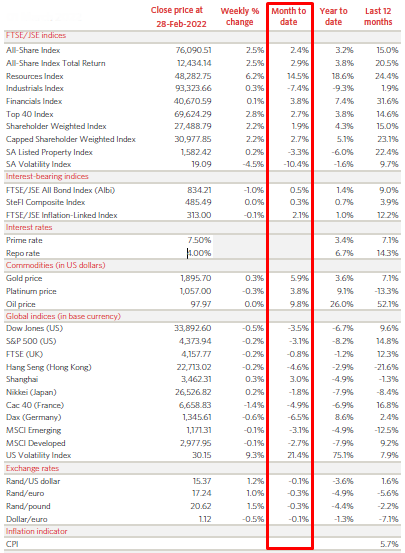
The red block shows the market stats for the month of February 2022. In short, the JSE All Share Total Return index was up ↑2.9% for the month (up ↑20.5% for the last 12 months). The Resources sector was the best performing sector for the month, up a whopping ↑14.5%. The Financial sector was also up but only by ↑3.8%. The Listed Property and Industrial sectors were both down ↓-3.3% and ↓-7.4% respectively.
11. Financial indicators as at 28 February 2022
Global indices: (NB! Returns are measured in Rand percentage points. For example, the S&P 500 was down -3.27% for the month as measured in Rands)

JSE Sectors:

Currencies: (NB! Positive indicates ZAR has weakened for the period, vice versa)

Interest Rates:

The information contained in this e-mail is of a general nature and is not a substitute for professional advice. We recommended that you obtain specific professional advice before you take any action. Vista Wealth Management takes all reasonable steps to ensure that the content of this e-mail is accurate and up to date, however, errors and omissions may occur. The accuracy of the information contained should therefore not be relied upon as a statement of fact.